SPARMAX FAQ
SPARMAX FAQ, airbrush FAQ, airbrush compressor, airbrush troubleshooting, airbrush cleaning, Flyer X, airbrush guide, SPARMAX airbrush


- Share
-

-

-

How do I choose the right compressor?
When choosing a compressor, do not look only at the maximum pressure. You should also consider the airbrush or spray gun you plan to use, operating time, spray area, airflow capacity, unit size, and working environment.
Can every compressor be used with any airbrush or spray gun?
Not necessarily. In addition to making sure the fittings are compatible, the compressor must also provide enough airflow for the airbrush or spray gun.
Even if the fittings can be connected, an airbrush or spray gun that requires more pressure or airflow than the compressor can supply may experience a drop in working pressure, unstable atomization, or poor spray performance.
For this reason, do not check only the fitting size or maximum PSI. You should also confirm the working pressure, airflow output (L/min), and air consumption of the airbrush or spray gun. If you are unsure, provide the full model numbers of both the compressor and airbrush/spray gun so compatibility can be checked.
Why does the compressor pressure drop when I press the airbrush trigger? Is this normal?
It is normal for the pressure reading to be lower while air is flowing than when there is no airflow.
Once the airbrush begins releasing air, the pressure drops to the actual working pressure. When adjusting pressure, press and hold the trigger so air is flowing, then check the pressure gauge and make your adjustment.
If the pressure drops and then remains stable, this is normal. If it continues to fall, airflow becomes progressively weaker, or the spray fluctuates, check the hose and fittings for leaks, the pressure regulator setting, and whether the air consumption of the airbrush or spray gun exceeds the compressor's airflow capacity.
Can I run the compressor continuously? Does it need time to rest?
We do not recommend operating a compressor continuously for long periods without a break.
To help prevent excessive heat buildup from prolonged motor operation, SPARMAX compressors should generally be operated for approximately 40-60 minutes, followed by about 10 minutes of rest, in accordance with the relevant product instructions.
Actual conditions may vary depending on the model, ambient temperature, and how the compressor is used. If the unit becomes noticeably hot, allow a longer cooling period.
Can the TC-620X operate two airbrushes at the same time?
Yes. The TC-620X has dual air outlets and can connect two airbrushes at the same time.
However, both airbrushes or spray guns share the compressor's available airflow and pressure, so actual performance depends on the combined air consumption of both tools. If you plan to use larger nozzle sizes or high-air-consumption tools simultaneously, check the airflow requirements of both first.
Why does moisture appear after the compressor has been running for a while? Do I need to do anything about it?
This is usually normal condensation caused by moisture in compressed air.
Air naturally contains moisture. After compression and temperature changes, that moisture can condense and collect in the air tank, moisture trap/regulator, or air hose. This is more noticeable in humid environments or during longer operating periods. For models with an air tank, we recommend releasing both pressure and accumulated moisture after each use.
What information should I provide if my compressor is not operating normally?
Please provide:
- The full compressor model number and serial number
- Approximate purchase date
- A detailed description of the issue
- Approximate operating time per session
- The airbrush or spray gun model being used
- Photos or videos showing the issue
For pressure or airflow issues, a video showing the pressure gauge, compressor operation, and airflow from the airbrush at the same time will make diagnosis easier.
How should I choose my first airbrush? Is a smaller nozzle always better?
A smaller nozzle is not always better. Choose based on your main application, spray area, and the material you plan to use.
- Model details, fine lines, and touch-up work: Consider a smaller nozzle size (0.2-0.3 mm)
- Full model painting, illustration, and general spraying: A 0.3 mm nozzle offers a good balance between detail and spraying efficiency
- Larger areas or higher-viscosity materials: A larger nozzle size (0.4-0.7 mm) is usually more suitable, together with a compressor that provides sufficient airflow
How fine you can spray also depends on paint thinning, air pressure, spraying distance, and technique, not only the nozzle size.
What is the difference between a single-action and dual-action airbrush? Which is better for beginners?
The main difference is how air and paint flow are controlled.
Dual-action airbrushes typically use downward trigger movement to control air and backward movement to control paint flow, allowing the amount of paint to be adjusted while spraying.
Single-action airbrushes simplify the controls and are more direct to operate. Neither type is universally better; the right choice depends on the application and the level of control you need.
Do I need to clean my airbrush after every use?
We recommend basic cleaning after every use.
If paint dries inside the airbrush, it may clog the nozzle or paint passages, causing irregular paint flow, unstable spray performance, or no paint flow at all. You do not necessarily need to fully disassemble the airbrush after every session. Remove the remaining paint and perform basic cleaning using a cleaning method and cleaner that are appropriate for the paint you used.
My airbrush suddenly stopped spraying paint or the paint flow is irregular. What should I check?
First determine whether there is no airflow at all, or airflow is present but no paint is coming out.
If there is no normal airflow, check the compressor, working pressure, hose, and fittings. If there is airflow but no paint, check whether the paint is too thick, the nozzle or paint passage is clogged, or the needle is installed correctly.
If basic cleaning does not solve the problem, avoid forcing or overtightening precision parts such as the nozzle. Contact customer support for further assistance.
What kinds of paint can I use with an airbrush? Can I use both water-based and solvent-based paints?
In general, both water-based and solvent-based paints may be used, but the key factors are paint formulation, viscosity, particle size, thinning ratio, drying speed, and airbrush nozzle size.
Whenever possible, use materials that the paint manufacturer identifies as suitable for spraying, and follow the manufacturer's recommendations for thinning and cleaning. If the material is too thick or contains large particles, it may cause poor paint flow or clogging even if it can enter the airbrush.
Can a damaged nozzle, needle, or other airbrush part be replaced separately?
Replacement and service parts are available for SPARMAX airbrushes and can be replaced as needed.
Because different models and nozzle sizes may use different parts, confirm the complete airbrush model before purchasing. If you are unsure which part you need, provide the airbrush model, a photo showing the part or area to be replaced, and a description of the issue so customer support can help identify it.
Are parts interchangeable between different SPARMAX airbrush models?
Different series, models, and nozzle sizes may use different specifications. Parts that look similar are not necessarily interchangeable. Check the product information on our website before purchasing. If you are still unsure, provide the full airbrush model and the part you need so customer support can help confirm compatibility.
What is an airbrush quick disconnect used for? Is it required?
It is not required, but it is very convenient if you frequently remove or switch airbrushes.
A quick disconnect allows the airbrush to be connected to or disconnected from the compressor hose without unscrewing the threaded fitting each time. It is especially useful when alternating between multiple airbrushes on the same compressor. When purchasing, make sure the airbrush, hose, and quick disconnect fittings are compatible.
How is Flyer X different from a conventional airbrush?
One of Flyer X's key features is its quick-change Bottle with Nozzle Set.
Different colors can be mixed in advance and prepared in separate bottle sets. When changing colors, simply swap the Bottle with Nozzle Set, reducing the need to repeatedly empty paint, remix colors, and clean between color changes.
Quick color changes do not mean cleaning is unnecessary. Full cleaning may not be required every time you switch colors during the same session, but proper cleaning is still required after the airbrushing session is finished.
Can Flyer X be used with any compressor?
For best spray performance, Flyer X is recommended for use at a working pressure of approximately 30 PSI.
If the compressor cannot provide sufficient airflow or pressure, you may experience a drop in working pressure, slower spraying, reduced atomization quality, or insufficient airflow during continuous use. For this reason, do not check only whether the fittings can be connected; the compressor's airflow capacity must also be considered.
What kinds of paint can I use with Flyer X?
Actual spray performance depends on paint type, viscosity, particle size, thinning ratio, and drying speed.
Whenever possible, use materials that the manufacturer identifies as suitable for spraying, and thin them according to the paint manufacturer's recommendations. When using a new paint or material for the first time, test a small amount first and confirm that paint flow and atomization are normal before beginning your project.
What is the correct way to change colors with Flyer X?
We recommend the following sequence:
After changing colors, perform a brief test spray first to confirm that the new paint flows normally before continuing. If you change colors frequently, you may also keep an additional Bottle with Nozzle Set prepared with cleaning solution.
Can I leave mixed paint in the Flyer X bottle and use it again later?
Depending on the characteristics of the paint, it may be temporarily stored in the Flyer X Glass Bottle. Remove the Nozzle Set and install the Flat Bottle Cap before storage.
However, not all paints are suitable for long-term storage. Storage results depend on paint type, thinning ratio, drying speed, and storage time.
Before removing a Bottle with Nozzle Set for temporary storage, close the Paint Control Cap completely as shown, then remove the set. Before using the paint again, check for settling, thickening, or drying, and make sure the nozzle remains clear.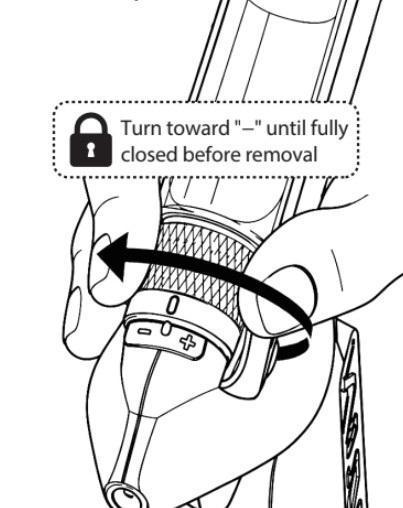
How should I clean Flyer X after use?
After each airbrushing session, clean the product using an appropriate airbrush cleaner for the paint you used.
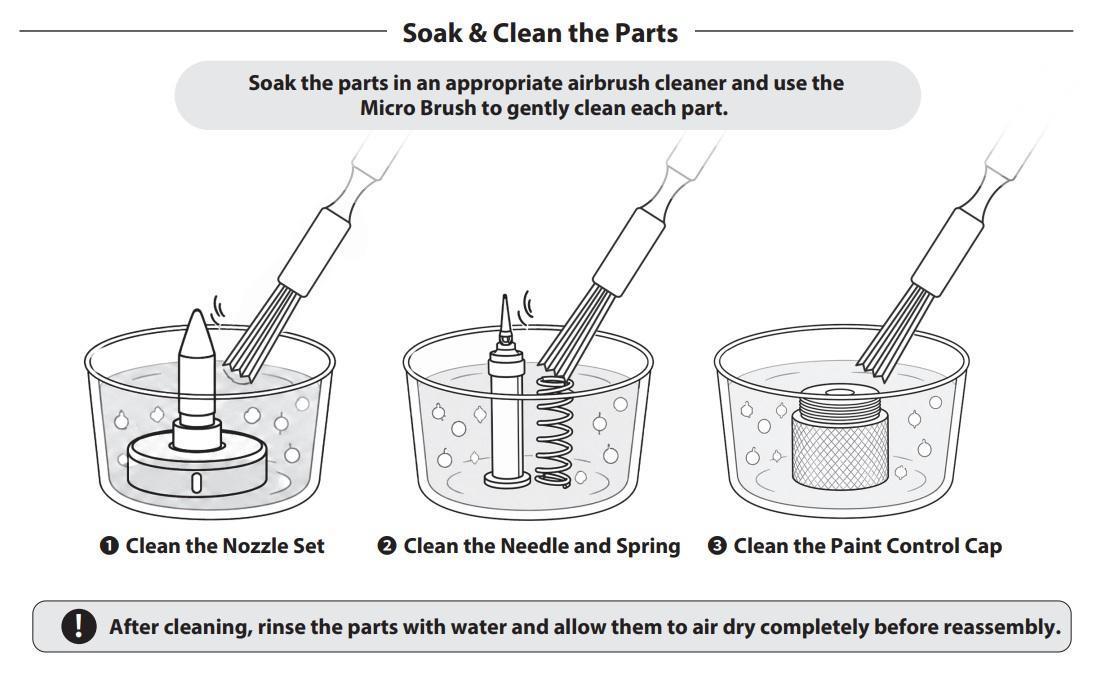
For more thorough cleaning, disassemble the Nozzle, Needle, Spring, and Paint Control Cap. Soak the parts in an appropriate airbrush cleaner, then gently clean them with the Micro Brush.
There is airflow after reinstalling the Flyer X bottle set, but no paint is spraying. What should I do?
If the Bottle with Nozzle Set is installed correctly and Flyer X has normal airflow but paint is temporarily not spraying, try the following:
- Close the Paint Control Cap completely.
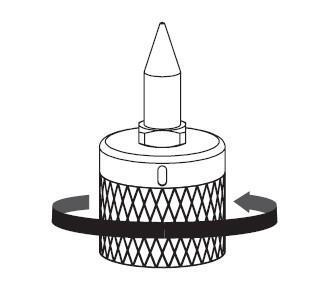
- Open the Paint Control Cap again.
- Reinstall the bottle set on Flyer X, then press the Trigger several times to spray.
If paint still does not spray normally, remove the Nozzle Set and clean it using a cleaner or thinner that is compatible with the paint.
Can I purchase additional Flyer X Glass Bottles and Nozzle Sets?
Yes. Additional Nozzle & Bottle Sets are available for Flyer X and can be purchased separately as needed.
If you change colors frequently, you can keep additional bottle sets ready to use, or reserve one set for cleaning solution.
Where can I find the Flyer X User Manual and Troubleshooting Guide?
For complete operating instructions, parts information, and troubleshooting guidance, please visit the official Flyer X Manual & Troubleshooting page.

